Britain built a padel court every nine hours this year.
Every padel club page in the United Kingdom, read in September 2026. Where the courts are, who books them, what players pay, who owns the clubs, what is opening next, and the two things that decide whether a club keeps its players.
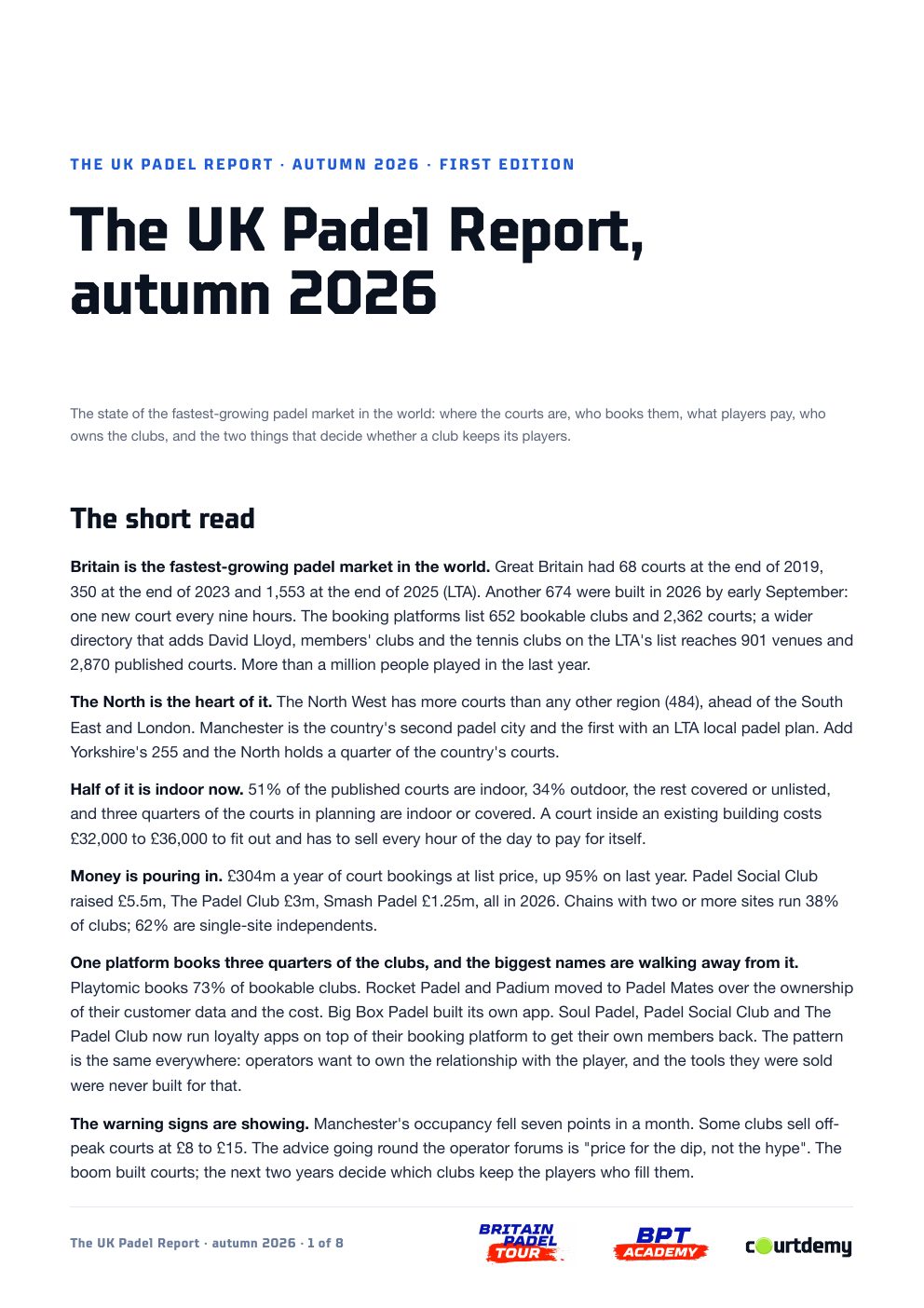
The short read
Britain is the fastest-growing padel market in the world. Great Britain had 68 courts at the end of 2019, 350 at the end of 2023 and 1,553 at the end of 2025 (LTA). Another 674 were built in 2026 by early September: one new court every nine hours. The booking platforms list 652 bookable clubs and 2,362 courts; a wider directory that adds David Lloyd, members' clubs and the tennis clubs on the LTA's list reaches 901 venues and 2,870 published courts. More than a million people played in the last year.
The North is the heart of it. The North West has more courts than any other region (484), ahead of the South East and London. Manchester is the country's second padel city and the first with an LTA local padel plan. Add Yorkshire's 255 and the North holds a quarter of the country's courts.
Half of it is indoor now. 51% of the published courts are indoor, 34% outdoor, the rest covered or unlisted, and three quarters of the courts in planning are indoor or covered. A court inside an existing building costs £32,000 to £36,000 to fit out and has to sell every hour of the day to pay for itself.
Money is pouring in. £304m a year of court bookings at list price, up 95% on last year. Padel Social Club raised £5.5m, The Padel Club £3m, Smash Padel £1.25m, all in 2026. Chains with two or more sites run 38% of clubs; 62% are single-site independents.
One platform books three quarters of the clubs, and the biggest names are walking away from it. It books 77% of the 652 bookable clubs. Rocket Padel and Padium moved to another platform over the ownership of their customer data and the cost. Big Box Padel built its own app. Soul Padel, Padel Social Club and The Padel Club now run loyalty apps on top of their booking platform to get their own members back. The pattern is the same everywhere: operators want to own the relationship with the player, and the tools they were sold were never built for that.
The warning signs are showing. Manchester's occupancy fell seven points in a month. Some clubs sell off-peak courts at £8 to £15. The advice going round the operator forums is "price for the dip, not the hype". The boom built courts; the next two years decide which clubs keep the players who fill them.
Where the courts are
Padel courts by region, open today.
| Region | Courts | Indoor | Outdoor | Venues | Typical off-peak court-hour | |
|---|---|---|---|---|---|---|
| North West | 484 | 272 | 155 | 123 | £26 | |
| South East | 361 | 126 | 161 | 144 | £30 | |
| London | 352 | 104 | 184 | 110 | £35 | |
| East of England | 278 | 100 | 117 | 101 | £30 | |
| South West | 276 | 167 | 70 | 70 | £24 | |
| Yorkshire and the Humber | 255 | 158 | 75 | 78 | £24 | |
| East Midlands | 221 | 145 | 52 | 70 | £28 | |
| West Midlands | 212 | 103 | 87 | 74 | £28 | |
| North East | 129 | 97 | 21 | 36 | £24 | |
| Northern Ireland | 115 | 91 | 8 | 24 | £24 | |
| Wales | 94 | 50 | 24 | 27 | £26 | |
| Scotland | 91 | 50 | 16 | 43 | £24 |
Courts counted from published club pages. About 110 venues, mostly David Lloyd clubs and tennis clubs, do not publish a court count, so the South East and East are understated. Indoor and outdoor do not add up to the total where a venue does not say.
Padel courts in Great Britain, year end
LTA to 2025 · bookable UK courts to 22 September 2026
Courts in Great Britain, year end: 68 (2019) · 96 (2020) · 150 (2021) · 226 (2022) · 350 (2023) · 767 (2024) · 1,553 (2025) · 2,362 bookable UK courts by 22 September 2026 (LTA to 2025; the booking platforms for 2026, which count differently).
Three things stand out
London has the most expensive courts and the most outdoor ones, which is the reverse of the rest of the country. The North West, the South West, Yorkshire and the North East are indoor markets: the warehouse club is the British model, and it is a model with a mortgage. And the single-court tennis and golf clubs of Scotland and the South East are a market of their own, on the LTA's own booking system or on nothing at all.
Who books the courts
What the club pays is rarely published. What every platform has in common is how it earns: when a court is booked. None of them earns when a player comes back.
They are occupancy tools, built to sell the hour, and they are very good at it. Retention was never their job, which is why the operators with the most to lose are building their own apps on top.
Who owns the clubs
The twenty operators with several sites or a flagship, and their 2026.
| Operator | Open today | 2026 |
|---|---|---|
| David Lloyd Clubs | 67 clubs, 129 published courts | Calls itself the largest UK padel operator; plans 220+ courts |
| Game4Padel | 26 sites, 58 courts | Valued at £27m (January 2025), backed by Andy Murray; rolling out PadelLevels |
| PadelStars | 14 sites, 47 courts | Radlett opening |
| Let's Go Padel | 12 clubs, 70 courts, Northern Ireland | Derry, Lurgan, East Belfast new |
| Powerleague | 12 clubs, 51 courts | Owned by Broadsword since 2025; Gateshead opened in September |
| PADELHUB | 9 clubs, 50 courts | Cancelled its free-court-time memberships |
| Pure Padel | 9 clubs, 49 courts | Expanding in warehouses |
| The Padel Club | 7 clubs, 45 courts; 8 more sites to 85 courts | £3m from the Northern Powerhouse fund, September 2026 |
| Smash Padel | 7 sites going to 20 | £1.25m, May 2026 |
| Padel Tree | 7 sites, 36 courts | Sutton Coldfield and Brentford next |
| Atmos Padel | 6 outdoor clubs | Backed by Arbor Ventures |
| S3 Padel | 5 sites, 39 courts | Derby (12) and Finchley Road (10) |
| Rocks Lane | 5 sites, 25 courts | London's tennis-and-padel centres |
| Slazenger Padel (Frasers Group) | 4 clubs, 38 courts | Leeds South (14) and Norwich next |
| Rocket Padel | 4 clubs, 35 courts | The UK's top club by bookings at Ilford; White City and Croydon next |
| Soul Padel | 3 clubs | 250 courts by 2032 |
| Padel Social Club | 3 London clubs | £5.5m, May 2026; The O2 and Kentish Town in November |
| Ignite Padel | 3 clubs, 23 courts | Speke growing to 17 courts |
| Carbon Padel | Manchester (17) and Rochdale (10) | The biggest club in the North |
| Padium | Canary Wharf, Cardiff Bay | London's most expensive courts |
Twenty-two venues have ten courts or more; the largest are Carbon Manchester (17), Rocket Padel Bristol, Padel Bonito in Yorkshire, Racketeer in London, Advantage Padel Mudeford and Jaxx Padel in Wales.
What players pay
The court-hour by city, with occupancy.
| Where | Court-hour | Occupancy | |
|---|---|---|---|
| UK average | £34 | 60% | |
| London | £47 | 70% | |
| Manchester | £37 | 69% | |
| Sheffield | £33 | 74% | |
| Birmingham | £33 | 67% | |
| Leeds | £32 | 68% | |
| Nottingham | £29 | 66% | |
| Bristol | £27 | 66% | |
| Belfast | £27 | 68% | |
| Edinburgh | £27 | 63% |
- Most courts cost £30 to £50 an hour; the off-peak average is £27.
- London's dearest: Padium £80, Rocks Lane £70, Padel Social Club £68.
- Manchester: Carbon £36 off-peak, £48 to £60 peak. Occupancy down seven points in a month.
- Sheffield's 74% is the highest in the country.
Every city, off-peak by region and what each of four pays: UK padel prices.
Building a court
What a court costs and earns.
Step by step, from the site to opening day: how to start a padel club.
Opening next
The sites with consent or a date, operator by operator.
| Operator | Where | Courts | When |
|---|---|---|---|
| Panoramic Padel | Speke | 13, 11 of them indoor | |
| Slazenger Padel | Leeds South | 14 indoor | |
| The Padel Club | Eight new sites: Chester, Liverpool, Knutsford, Sheffield, Cardiff, Brighton, Sutton Coldfield | To 85 courts | |
| Soul Padel | Six consented sites: Ayr, Washington, Warrington, Preston, Wigan, Rochdale | ||
| Padel Tree | Sutton Coldfield and Brentford | 8 and 4 | |
| Padel + Play | Burntwood | 8 | |
| Padel Social Club | The O2 and Kentish Town | 17 between them | November |
| Rocket Padel | White City and Croydon | ||
| City Padel | Plymouth | 8 | October |
| ARDA | Windsor | 6 | Spring 2027 |
| Smash Padel | Taunton, then on to 20 sites |
The two things that keep a player
The boom has been measured in courts. The next two years will be measured in players who are still playing. Every operator who has run a club through a winter knows the two levers, and neither of them is a court.
The first is coaching. A player who has never had a lesson plays until the first bad month: a run of losses, a partner who moves away, a knee. A player who is coached has a reason to come back that does not depend on winning: the next session in the programme, the level they are working towards, the coach who knows their name and their backhand. Coaching turns a booking into a membership. The clubs with the best retention in the country are, without exception, the clubs with the strongest coaching programmes, and the operators raising money this year all say the same thing in their decks: coaching is the anchor product, the court is the venue for it. Yet coaching sits outside every booking platform. Lessons are booked by WhatsApp, programmes are run on spreadsheets, a player's level is a number they typed into a quiz, and a coach's judgement, the most valuable piece of data a club owns about a player, is written nowhere.
The second is the app in the player's pocket. For most players the app is the club. It is where they find a match at their level, where they book the lesson, where they hear about Friday's Americano. Whether they come back on a Tuesday in February depends on whether that app gives them a reason: a match with people they can beat and be beaten by, a level that means something, a programme with a next session in it. Today the app in the player's pocket belongs to a platform whose revenue comes from the booking, not the return, whose level is self-declared and gamed, and whose terms decide how the club may speak to its own members. The clubs that noticed this first are the ones building their own apps, and they are right to. What they need is not another way to sell the hour. It is a platform built for retention: coaching, matches and events in one place, with a level a coach signed.
There is no such platform in the market today. That is the gap this report was written to describe, and it will be the measure of next year's edition: not how many courts were built, but how many of last year's players are still on them.
How we counted
- Every padel club page in the United Kingdom, read in September 2026.
- 652 bookable clubs and 2,362 courts on the booking platforms, as Playskan counts them, to 22 September 2026.
- Our own directory adds David Lloyd, members' clubs and the LTA's tennis clubs: 901 venues, 2,870 published courts.
- About 110 venues publish no court count, so the South East and East are understated.
- Year-end counts to 2025 are the LTA's. 2026 is the booking platforms' count, which counts differently.
- Prices are the listed court-hour, averaged by city. Occupancy is Playskan's estimate from live court availability.
- £304m a year is Playskan's estimate of court bookings at list price.
- Build costs are the LTA's figures.
How to cite
courtdemy, The UK Padel Report 2026, first edition, September 2026. courtdemy.com/reports/uk-padel-2026
Quote any number with a link to this page. The PDF has the same numbers: eight pages, free.